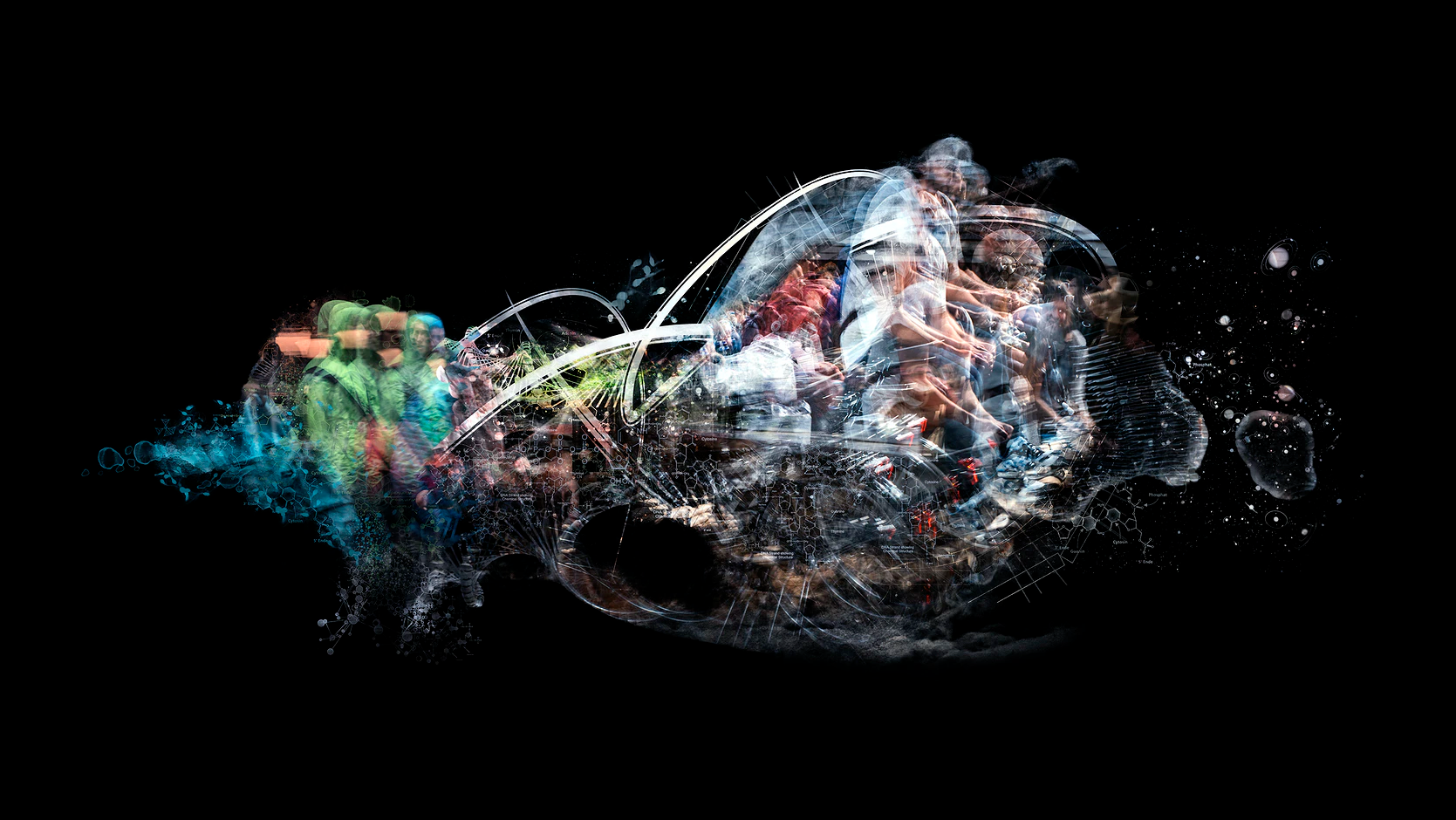
When we truly attend to the world around us, we may find ourselves astonished by the simplest things: the first sunlight reaching our eyes, a bee making honey, a flower opening. These encounters feel more real than so much of what troubles us in modern daily life. Among the things we most need to recognize is the light within us that never goes out.
Ancient philosophical traditions understood the human being as a key to the extraordinary order of the universe and the mystery of life: a living reflection of a divine design. Within the Pythagorean tradition, the relationship between the human being and the universe is conceived as one between a small world and a larger whole. To understand one is to approach an understanding of the other. In this vision, the cosmos is alive: celestial bodies may be imagined as dwellings for spirit and intelligence, just as the human body carries an invisible inner life.
The Greek word cosmos evokes order and beauty. To speak of the cosmos is to speak of the universe as an indivisible whole, encompassing everything from the smallest constituent to the largest structure. To make this whole more intelligible, we approach it through two perspectives: the macrocosm and the microcosm. One directs our attention toward the vast; the other, toward the minute.
The spiritual and philosophical traditions of ancient Greece, Persia, India, and Egypt explored the relationship between the greater world and the human world. For me, their enduring question concerns the connection between the macrocosm and the microcosm, between the divine and the human.
The Hermetic tradition associated with the Emerald Tablet expresses this relationship through a correspondence between what is above and what is below. Read symbolically, this suggests that the visible and invisible, the inner and outer, and the part and the whole may illuminate one another.
Visual resemblances across these scales can be startling. The familiar image of an atom may bring a solar system to mind; the structures within a cell may recall a galaxy. I approach these correspondences as visual and poetic analogies, not as scientific equivalences. They invite us to imagine relationships between forms that ordinarily seem immeasurably distant from one another.
Movement provides another thread between them. From the microscopic world to planetary orbits and the changing relationships of galaxies, the universe offers an image of continual transformation. In my work, this becomes the sense of an unending dance: a world that cannot be reduced to a fixed, motionless structure.
This movement also offers a way of thinking about our lives. The movement we once associated most readily with clouds, rivers, the sun, and the earth now finds its counterpart in the ceaseless activity of cities. Trails of light from cars, people at their desks or filling the streets, skyscrapers, vast factories, and moving advertisements compose another landscape of motion.
The accelerating technologies of the twenty-first century have entered this landscape and reshaped our daily existence, at times making us resemble the machines we use. My work brings together the organic structure of the world above—the universe—and the artificial, complex structures we have built below, on Earth. Through this encounter, I consider a process that moves from the natural toward the artificial, from variety toward standardization, and from humanity toward mechanization.
The city, this world below, resembles the world above in its restless change and transformation. It, too, can be imagined as a living organism. In my images, the rapid passage of urban traffic and the back-and-forth movement of people travelling to work blur into patterns that evoke the universe, fractal forms, and the structures of DNA.
In Cosmos, Carl Sagan draws attention to the stellar origins of elements found in our bodies and throughout our everyday world. His account invites us to recognize that our existence is inseparable from the history of the universe. If we carry that history within us, perhaps the study of our own bodies and genetic inheritance can also deepen our sense of belonging to a larger whole.
The imagery of rotation and a spiritual center in Rumi's thought offers another way to approach this relationship. Perhaps understanding the universe begins with recognizing the significance of life here on Earth. The Hermetic idea of correspondence likewise invites us to consider the part as an expression of the whole, and to ask how a change in one might transform our understanding of the other.
Through these works, I seek to express that we are children of both the sky and the earth. Our passage through this world is not only a discovery of the universe; it is also a discovery of ourselves.
Ali Alışır
2016