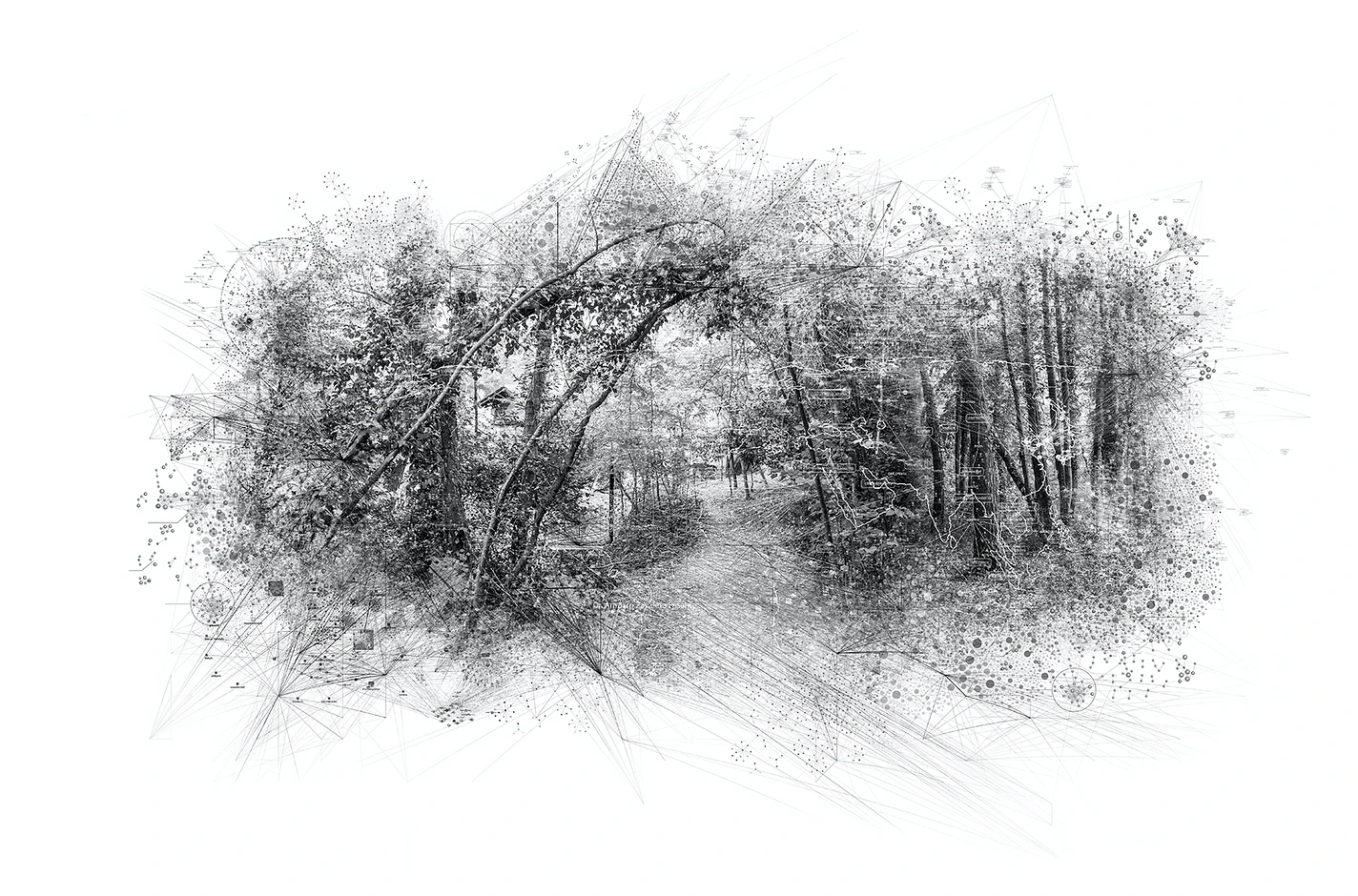
Technology has always seemed capable of miracles. Through it, we have made real what scientists once only dreamed of. Yet the pace of contemporary life, the sophisticated electronic devices we use, and the enclosed spaces in which we spend so much of our time draw us further from nature. Since the nineteenth century, technological progress has promised more leisure, but that promise sits uneasily beside the demands of working life. Technology was meant to serve us; increasingly, it seems that we serve it.
Have these changes made us happier? Does the closeness made possible by technology mean that we are genuinely close to one another?
We once seemed to know one another—and one another's stories—more intimately. Today, the circulation of information does not necessarily bring that familiarity with it. In the world Marshall McLuhan described through the idea of a global village, information travels around the earth with ease and communication takes place in an instant. Yet we may still know little of the lives behind the messages.
Knowledge has traditionally been understood as a body of understanding acquired through learning, research, experiment, and observation: something that can be recorded, examined, and returned to. The postmodern perspective that interests me shifts attention from the search for a single truth to the ways truth itself is constructed and circulated. Its concern is not simply to establish another truth, but to expose the processes through which multiple truths come into being.
Virtual Landscapes addresses the removal of information from its original context—from the reality to which it belongs—followed by its reproduction and circulation. I explore this process through the tree, one of the oldest and most enduring symbols of knowledge.
Across mythologies and spiritual traditions, the tree has been associated with knowledge, the sacred, and the structure of the universe. In stories of Eden, the forbidden tree and its fruit bring together questions of knowledge, transgression, and the human condition. Other traditions connect the tree with life, resurrection, and passage between worlds. The cross, the sacred staff, and the festive tree belong to a wider constellation of tree imagery, although the meanings of these symbols differ across beliefs and histories.
The tree also enters literary and mystical accounts of the world. Dante's Divine Comedy draws on the imagery of Eden, while other traditions imagine trees whose forms overturn the ordinary relationship between roots and branches. As a symbol of both the cosmos and the human spirit, the Tree of Life can be read as a map joining macrocosm and microcosm. In Kabbalistic thought, it offers a way to contemplate the structure of creation and the relationships within it. Knowledge and life meet within this symbolic field, even where their trees remain distinct.
Among the natural forms invested with sacred meaning—mountains, stones, fire, water—the tree holds a particular place. Its roots bind it to the earth while its branches reach toward the sky. Through repeated cycles of shedding leaves and coming into leaf, it renews itself. It becomes an image of continuity, and of life returning after death.
Turkic mythology contains stories that honor the tree and the forest, expressing the power attributed to them and the respect they command. In these narratives, the tree may mediate between heaven and earth and become associated with the divine blessing granted to rulers. The traditions surrounding Oğuz Khan and Bögü Tegin bring trees into accounts of origins, kinship, and sovereignty. Within this imaginative world, the tree is a passage through which human life approaches the sacred.
In Sakha and Altai traditions, the Tree of Life is also imagined as a World Tree. It connects the center, or navel, of the earth to other realms and to the celestial axis associated with Demir Kazık, the Iron Stake. Its branches provide an image of the shaman's ascent toward the higher heavens. Solitary and self-sustaining, the tree does not depend on human beings in the way that human beings depend on it.
A scene in the documentary Cengiz Han'ın İzinde remains with me: members of a Kalmyk family embrace trees, kiss them, and speak to them. Their words evoke trees that continue to address us even as we pass without listening—beings that have witnessed much and that offer generosity, affection, and the possibility of healing. The encounter gives an intimate, human form to a relationship that abstract accounts of nature often overlook.
With roots extending into the earth and branches reaching into the sky, the Tree of Life becomes an imagined route by which humanity approaches the Creator. In this reading, reverence for the tree is directed toward what it connects, rather than simply toward the tree as an object. It marks the meeting of the world's center and the universal axis: a path toward eternity.
The shamanic tree can likewise be understood as a ladder toward the heavens. In the imagery of the Iron Tree, the earth is joined to the navel of the sky and sustained through that connection. The bond is imagined as an umbilical cord, as essential to the life of the world as the cord that nourishes a child in the womb.
This cosmic axis is another form of the Tree of Life. It marks a symbolic center in which the origins of human existence can also be imagined.
In different religious traditions, the tree offers a place to encounter the sacred. People gather near trees, entrust wishes to them, and imagine a connection with a greater reality. The Buddhist account of enlightenment beneath the Bodhi tree gives this relationship another form. Across Turkic and Islamic cultural contexts, images of the sacred tree, the tree of sovereignty, the golden tree, and the tree of paradise offer changing ways of expressing spiritual and worldly order. Ottoman tree imagery likewise connects sovereignty with the memory of ancestors.
In Sufi thought, the image of the world as a tree allows the human being to be understood as one of its fruits. The association of this image with Mevlânâ belongs, for me, to a broader cultural memory in which trees carry ethical and emotional meaning. Stories of Atatürk's care for trees, the walnut tree in Nâzım Hikmet's poetry, and the plane tree associated with Osman Bey each give this memory a different form. In this sense, the Tree of Life can hold the past and the future together.
The family tree offers a related image: a tree that recalls its ancestors while its branches extend toward the generations to come. Across these symbolic traditions, the tree has served both as a way of understanding natural forces and as a means of imagining communication with the divine.
Today, technology gives a new dimension to the meanings we assign to nature and to the tree within it. What increasingly takes the place of the natural world in our shared imagination is a landscape produced through design and projection. It resembles neither the landscapes of Cézanne and Pissarro nor the other painted landscapes of modern art. The world we now inhabit is threaded with social networks and continually invites us to share. We do not merely exchange nature for technology; we add artificial structures to it. By presenting trees and natural forms covered in internet networks, I emphasize not only our distance from nature, but also our efforts to construct virtual worlds.
Virtual Landscapes brings these two worlds of knowledge together: the symbolic tree of the past and today's internet as a space of social exchange. In a world that appears increasingly transparent, every image and text is offered for circulation. Yet behind this abundance of visibility, we may encounter a landscape in which there is surprisingly little left to see or to learn. The work asks what remains behind the surfaces made available to us for sharing.
The unlimited, instantaneous circulation offered by the digital world carries the risk that this landscape may turn into an abyss. The critique of simulation associated with Jean Baudrillard helps me think about a world in which even imagination seems to be pre-empted by what is already presented to us. Perhaps our condition resembles that of a tree that has lost its shadow. Instead of putting down roots, we expand without grounding, in a growth that begins to resemble a tumor.
Ali Alışır
2014