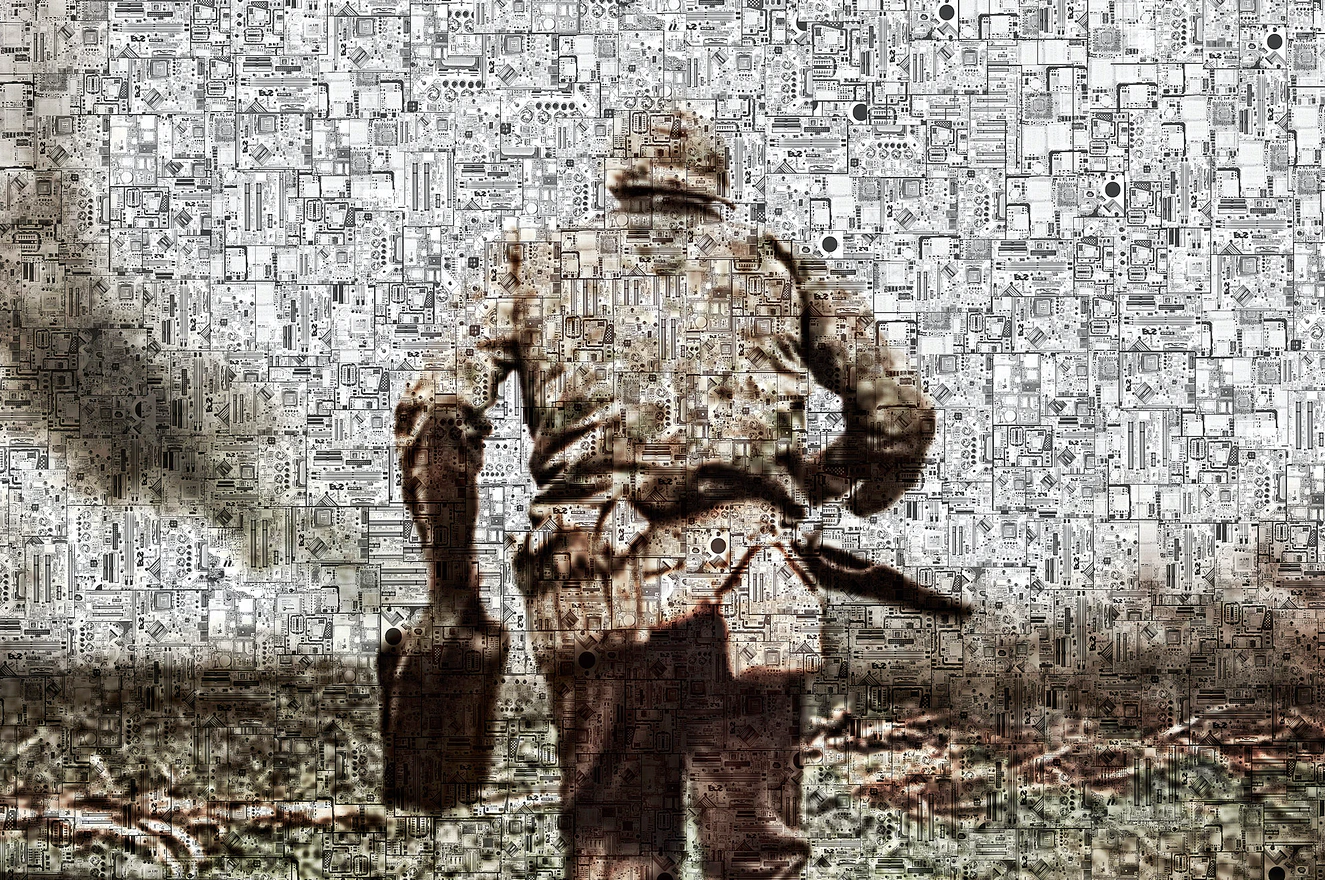
The rapidly developing technologies of the twenty-first century have shown us that even the most brutal wars can be presented as entertainment. From the televised images of the Gulf War to the wars in Afghanistan and Iraq following the September 11 attacks, increasingly sophisticated technologies have shaped how conflict reaches us. Sitting in comfortable armchairs, we have watched attacks that devastate civilian lives as though we were watching fireworks or playing a video game.
History has known immense wars, invasions, and losses, but the spectacle of conflict has acquired a new immediacy. Entertainment and combat become entangled as commercial media present war in compelling, visually attractive forms. Events unfold in a continuous live broadcast, like a reality show. The roles of reporter and combatant begin to overlap: alongside journalists' images, footage reaches us from cameras carried by soldiers or mounted on military vehicles. The image comes to frame the event before we can comprehend the war itself.
In Regarding the Pain of Others, Susan Sontag explores photography's enduring relationship with death. Today, I would argue, photography has also entered an intimate relationship with capital. In the media's presentation of war, technical capability and numerical information can take precedence over the experience of reporting. Losses, destroyed cities, civilian deaths, and devastated places are translated into statistics and digital codes. Numbers begin to seem like war's only evidence. The strategic value of occupied territory is measured and revised, while maps and graphs turn the advances of opposing forces into displays of achievement.
This astonishing spectacle, extending across the world, is reduced to figures and marketed through a culture of entertainment. What is offered for consumption is not the reality of war but its compelling surface.
From the spectator's position, it can seem as though these wars have never really happened. Images on television produce a narcotic effect, as if turning off the screen might also bring the fighting to an end. Yet actual wars continue in the shadow of their virtual counterparts. Behind the visible spectacle, I see wars of capital: struggles that the images both reveal and conceal. The battlefield becomes a screen behind which other forms of power operate. In this sense, warfare can no longer be understood only through guns and weapons.
Paul Virilio's reflections on war, speed, and media help frame the question of how conflict enters the commercial rhythm of broadcasting. When war coverage and major entertainment events occupy the same media economy, audiences, sponsors, and the continuity of programming become part of the conditions under which war is represented. The question is not only what we are shown, but how the spectacle is scheduled and made consumable.
War can then move through the television schedule with its flow and appeal intact, appearing to be one ordinary segment in an uninterrupted stream. Its presentation becomes difficult to distinguish from that of other consumer products. Through this aesthetic transformation, the spectator is drawn into the position of a virtual player.
I understand this condition as a process that continually reproduces itself. Traditional definitions of war no longer fully describe it. Alongside military force, conflict operates through command-and-control systems, cyberwarfare, psychological operations, broadcast schedules, and the online and multimedia circulation of information through cultural and social life.
The terrifying face of war becomes a scene to be watched: a technological display seemingly stripped of bodily pain and sensory experience. Television and online broadcasts present weapons fired and bombs falling at night as patterns of light, recalling fireworks or an illuminated Christmas tree. Destructive power acquires a seductive appearance. Joseph DeLappe's critique of war as a game points to what this appearance can conceal: the slaughter, the coffins returning home, and the suffering excluded from a sanitized view of conflict.
Another aspect of virtual war is the consumption of pleasure and indulgence. The spectacular worlds of cinema and games have helped encode conflict in these terms. When their virtual imagery is combined with footage of actual war, reality is pushed behind the scenes. In the logic of the image, the distance between the pilot concentrating on a target and the viewer concentrating on a screen appears to collapse. Virtual war becomes a new means of enacting military fantasies.
Ernst Cassirer describes human beings as inhabiting a symbolic universe rather than a merely physical one. Language, myth, religion, and art are among the forms through which this universe takes shape.
Today, these social, artistic, religious, and political relationships increasingly pass into virtual space. I am concerned with what happens when words lose their metaphorical depth and images their symbolic relationships: when digital signs appear to refer only to themselves, rather than to a reality beyond them.
Images of war undergo a similar transformation. Through increasingly sophisticated technologies, they can become a system of signs detached from the conflict they purport to show. The traces of lived experience are displaced by codes and recurring visual patterns.
The enemy is no longer encountered simply as an other. On an electronic surface where civilian and military information converge, individuals risk becoming complicit in the spectacle. Heroes and villains are reduced to dark points on an illuminated display. War and freedom lose the clarity of their separate meanings. Within virtual war, the objective seems to shift from occupying a defined piece of territory to appearing across it as an unsettling, elusive presence.
An attack or invasion ordinarily allows us to identify a place from which to defend ourselves. But how can that response be organized when the operations of war become difficult to see? The apparent invisibility of contemporary conflict unsettles the very distinction between attack and defense.
Every war has produced its own spectators. As our identities and relationships become virtual, the wars we witness also take place in virtual environments. There, conflict can perpetuate itself without interruption and begin to stand in for reality. The emotional numbness and exhaustion caused by relentlessly vivid images may become the most lasting scars carried by those who watch.
Ali Alışır
2013